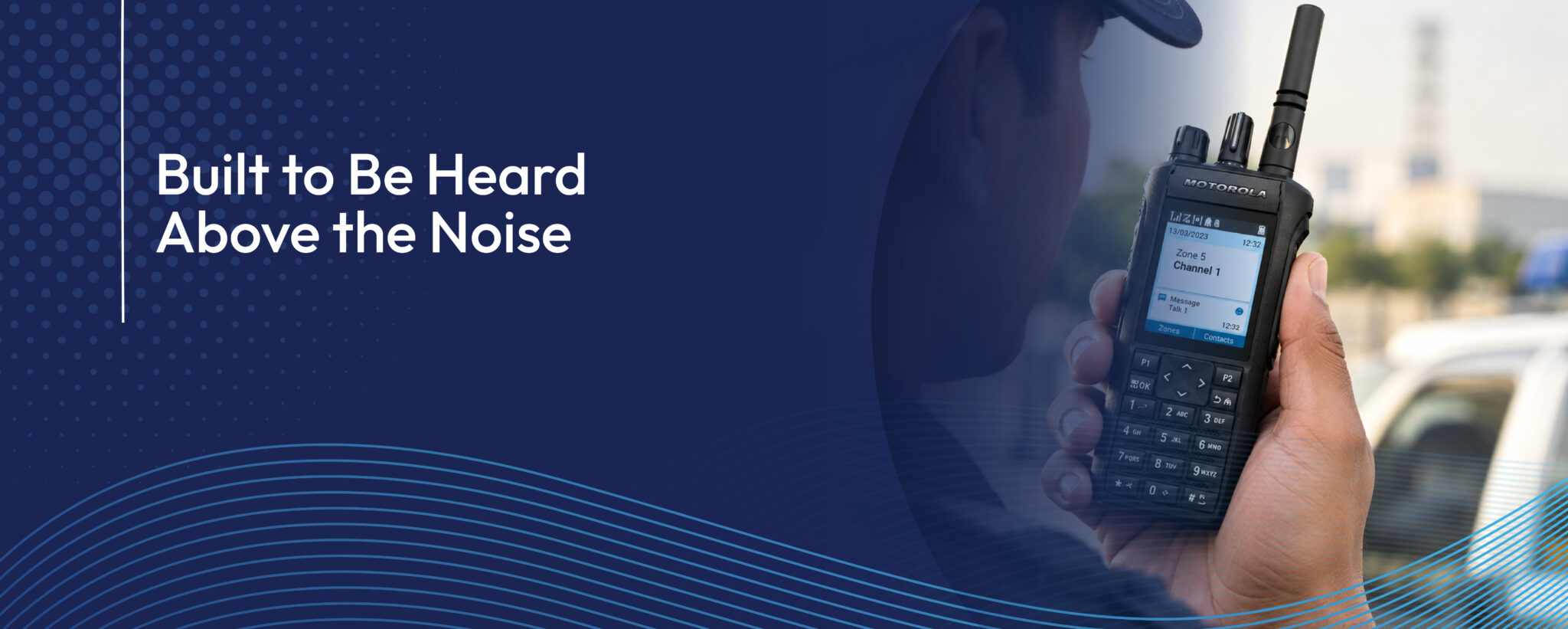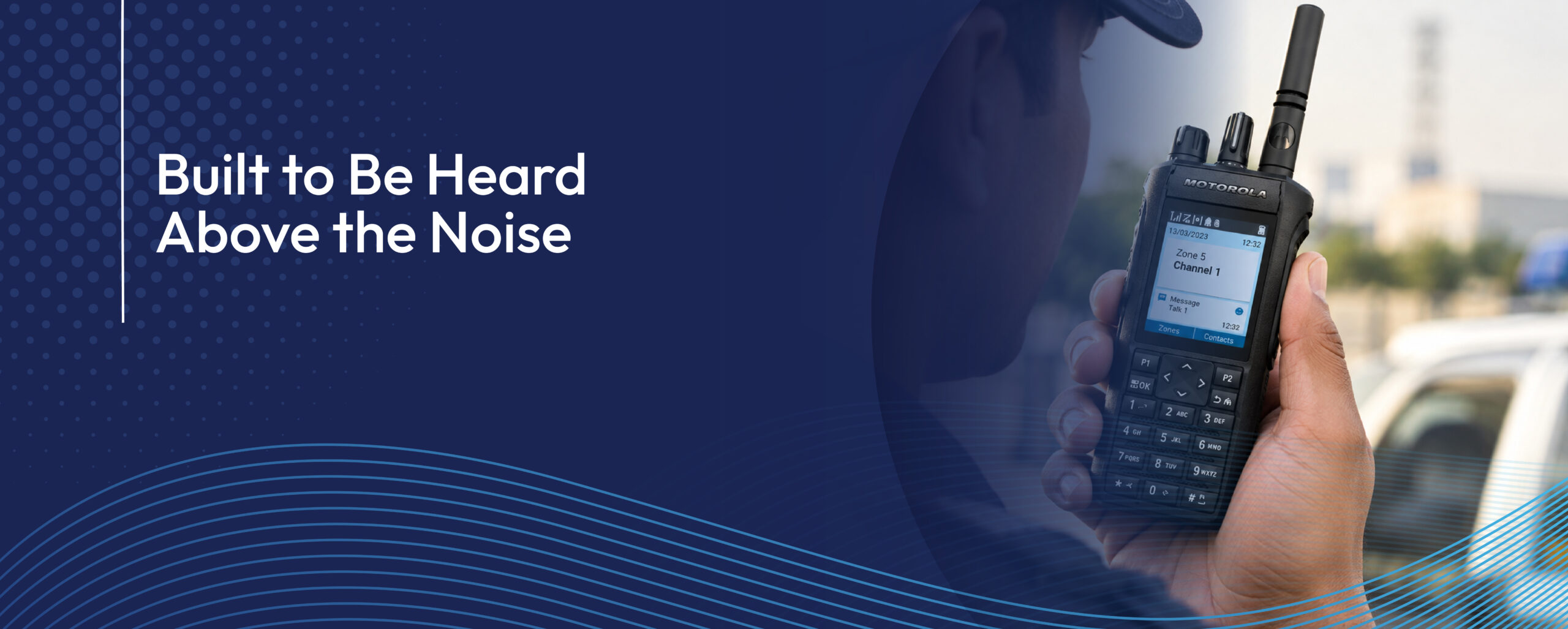
Built to Be Heard Above the Noise blog banner Sheetal 2

How to Improve Communication in Noisy Industrial Environments with the Motorola R7 Walkie-Talkie

Introduction

In a manufacturing or steel plant, machinery can operate at full capacity while supervisors and workers coordinate tasks across busy production areas. When an important instruction is lost beneath the sound of engines, conveyors, furnaces, or heavy equipment, a simple message may need to be repeated, slowing response and potentially increasing operational risk.  

Clear industrial communication requires more than basic voice transmission. The Motorola R7 walkie-talkie is designed for demanding environments, combining advanced audio processing with rugged construction. Its adaptive dual-microphone noise suppression, Intelligent Audio, automatic acoustic feedback suppression, and programmable loudness help teams hear and be heard in challenging conditions. Its IP68/IP66 protection and MIL-STD 810 ruggedness further support operation in demanding workplaces

Why Does Industrial Noise Cause Communication Breakdowns?

Industrial environments create several challenges for voice communication. Heavy machinery, production equipment, vehicle movement, alarms, and other background sounds can make conversations difficult to hear or understand.  

Workers may also be wearing helmets and hearing protection, while multiple teams communicate simultaneously across different production zones. Physical barriers, large facilities, and indoor-outdoor transitions can further affect how clearly instructions are received.  

When a message is misunderstood, teams may need to repeat instructions or physically move closer to communicate. During operational incidents, even a short delay can affect coordination and response.  

This is why an industrial two-way radio needs to deliver more than connectivity. It must provide clear, audible, and immediate communication despite changing workplace conditions. 

How Does the Motorola R7 Support Clearer Communication?

The MOTOTRBO R7 is built around advanced audio processing designed to maintain clear communication in environments where background noise can be challenging

Adaptive Dual-Microphone Noise Suppression

The R7 uses adaptive dual-microphone noise suppression to reduce background noise during voice transmission. This helps distinguish the speaker’s voice from surrounding sounds, making it particularly relevant to manufacturing floors, steel plants, and other high-noise areas

Intelligent Audio

Intelligent Audio automatically adjusts speaker volume according to the surrounding noise environment. This reduces the need for users to manually change volume levels as they move between quieter and louder areas.

Programmable Loudness

The R7 supports programmable loudness of up to 107 phons, helping make voice messages more audible in loud industrial settings.  

Wideband Audio

Its wideband speaker and microphones are designed to support voice clarity, complementing the radio’s broader audio-processing capabilities.

Motorola R7 Merged Table
Communication Problem Motorola R7 Capability Practical Value
Machinery noise Dual-microphone noise suppression Helps reduce transmitted background noise
Changing noise levels Intelligent Audio Supports consistent audio performance
Messages are difficult to hear Loudness up to 107 phons Helps make messages more audible
Acoustic feedback Feedback suppression Helps reduce disruptive feedback
Unclear speech Wideband speaker and microphones Supports clearer voice communication

How Does the Motorola R7 Handle Demanding Workplaces?

Audio clarity is only one part of industrial communication. A radio used on a factory floor or steel plant must also withstand the physical conditions of the workplace.  

The R7 offers IP68 protection, including water immersion up to 2 metres for up to two hours, as well as IP66 protection against concentrated water jets. It is also rugged to MIL-STD 810 standards and features a robust, corrosion-resistant side connector.   

The radio’s housing is also designed to withstand approved disinfectants and decontamination substances, which can be valuable in environments where equipment hygiene is important.   

Battery configurations can provide up to 28 hours of battery life under specified conditions, supporting extended operational shifts. Actual runtime varies according to the battery, configuration, enabled features, frequency band, and usage.   

UHF and VHF options allow organisations to select a configuration suited to their communication environment. Intrinsically safe R7 configurations are also available as an option; this does not mean every R7 model is intrinsically safe

4. Where Can the Motorola R7 Be Used?

Manufacturing Plants

Manufacturing facilities often have multiple production lines operating simultaneously, creating significant background noise. A walkie-talkie for factory use with advanced noise suppression and loudness capabilities can help supervisors, operators, maintenance teams, and safety personnel coordinate without relying on face-to-face communication

The R7 also supports extensive communication networks, with full-keypad models supporting up to 1,000 channels according to Sheetal Wireless’s product information.

Steel Plants

Steel plants combine high noise levels with demanding environmental conditions. Clear voice transmission, rugged construction, and appropriate radio configuration become particularly important when teams need to coordinate around production areas and material-handling operations.  

Other Industrial Applications

The R7 can also support communication across power-generation facilities, construction sites, utilities, material-handling operations, and emergency or security teams where durable two-way radios for manufacturing and industrial coordination are required

What Should Businesses Check Before Deploying the Motorola R7?

Choosing an industrial walkie talkie requires consideration of the complete communication environment rather than the radio alone.  

Businesses should evaluate:  

  • Full-keypad or no-keypad model requirements   
  • UHF or VHF frequency requirements   
  • Indoor and outdoor coverage   
  • Building layouts and physical obstructions   
  • Repeater compatibility   
  • Battery and charging requirements   
  • Audio accessories   
  • Frequency licensing   
  • Emergency-feature configuration   
  • Intrinsically safe certification, where required   
  • Radio programming and coverage testing   
  • Employee training   

Full-keypad models support up to 1,000 channels, while no-keypad models support 64 channels.

Communication range should also be assessed realistically. It depends on frequency, antenna, terrain, buildings, programming, and repeater infrastructure rather than a single advertised range

Sheetal Wireless can help organisations evaluate the appropriate Motorola R7 model, frequency band, accessories, and radio-network configuration based on site conditions.


Conclusion

Industrial noise can turn a simple instruction into a repeated message and a potential operational delay. The MOTOTRBO R7 addresses this challenge through advanced audio capabilities and rugged construction designed for demanding environments.   

However, effective communication also depends on the right frequency, accessories, programming, coverage planning, and network infrastructure. Consult Sheetal Wireless to discuss Motorola R7 configurations, accessories, coverage planning, and deployment requirements for your industrial facility. 

FAQ

Is the Motorola R7 suitable for noisy industrial environments?

Yes. Its adaptive dual-microphone noise suppression, Intelligent Audio, automatic acoustic feedback suppression, wideband audio, and programmable loudness are designed to support clear communication in challenging acoustic environments.

The R7 carries IP68 protection for water immersion up to 2 metres for two hours and IP66 protection against concentrated water jets. These ratings should be understood as specific protection levels rather than a claim that the radio is completely waterproof under every condition.

Depending on the battery and operating conditions, the R7 can provide up to 28 hours of battery life under specified test conditions. Actual runtime varies with configuration and usage.

There is no single fixed range. Actual coverage depends on frequency, antenna configuration, terrain, buildings, programming, and repeater infrastructure.  

Related Blogs